在 Geophysical Journal International 發表的理論研究中,提出了一套具一致性的多參數貝氏全波形逆推框架。該方法強調模型參數(密度、P 波與 S 波速度)之間的物理相關性,並透過非對角的模型共變異數矩陣作為逆推中的先驗資訊,有效降低了參數之間的逆推交叉干擾與不穩定性問題。數值測試顯示,此方法在逆推深部密度與剪切波速度異常方面,能顯著改善傳統方法的限制。
2. 在卡斯卡地亞隱沒帶的實地應用(Kan et al. 2023, JGR: Solid Earth)
第二篇研究將此方法首次應用於美國奧勒岡州的 Cascadia 隱沒帶,透過對 teleseismic P 波與 SH 波完整波形的逆推,成功解析出一層東傾、厚度僅 10 公里的低速層,與過去 receiver function 觀測到的流體飽和洋殼相一致。
Development and Application of Full-Waveform Inversion for Regional-Scale Crust and Upper Mantle Imaging
In recent years, geophysical research has increasingly shifted from traditional traveltime tomography to full-waveform inversion (FWI), a technique that utilizes complete seismic waveforms to achieve high-resolution subsurface imaging. By capturing both phase and amplitude information, FWI offers significantly improved sensitivity to complex geological structures.
This research theme, initiated in 2022, evolved through a logical sequence: establishing a theoretical framework, validating the method in a well-studied subduction zone, and applying it to the structurally complex region of Taiwan. It represents a coherent and integrated development in both methodology and geophysical application.
1. Theoretical Foundation (Kan et al. 2022, GJI)
Published in Geophysical Journal International, the 2022 study introduced a consistent Bayesian multiparameter inversion framework for isotropic elastic media. The novelty lies in incorporating prior correlations between model parameters—density, P-wave velocity (VP), and S-wave velocity (VS)—through a non-diagonal model covariance matrix.
Synthetic tests demonstrate that this approach significantly reduces parameter trade-offs and enhances the recovery of density and shear wave anomalies at depth, particularly in teleseismic settings where sensitivity to deep structures is limited.
2. Application to the Cascadia Subduction Zone (Kan et al. 2023, JGR: Solid Earth)
The second study applied this inversion scheme to the Cascadia subduction zone in central Oregon, using teleseismic P and SH waveforms from the CASC93 array. The resulting models revealed:
A thin (<10 km) east-dipping low-velocity layer interpreted as the fluid-saturated subducting Juan de Fuca oceanic crust.
A progressive increase in velocity and density below 40 km, marking the onset of eclogitization.
Upward migration of silica-rich fluids into the forearc mantle, triggering serpentinization and reducing seismic velocities.
Extremely low VP/VS ratios in the forearc crust, indicating extensive quartz mineralization.
A low-velocity, high VP/VS anomaly beneath the volcanic arc at ~75 km depth, consistent with partial melting triggered by slab dehydration.
These results provide direct seismic evidence for deep fluid transport, metamorphic reactions, and melting processes, linking them with structural and compositional changes in the lithosphere.
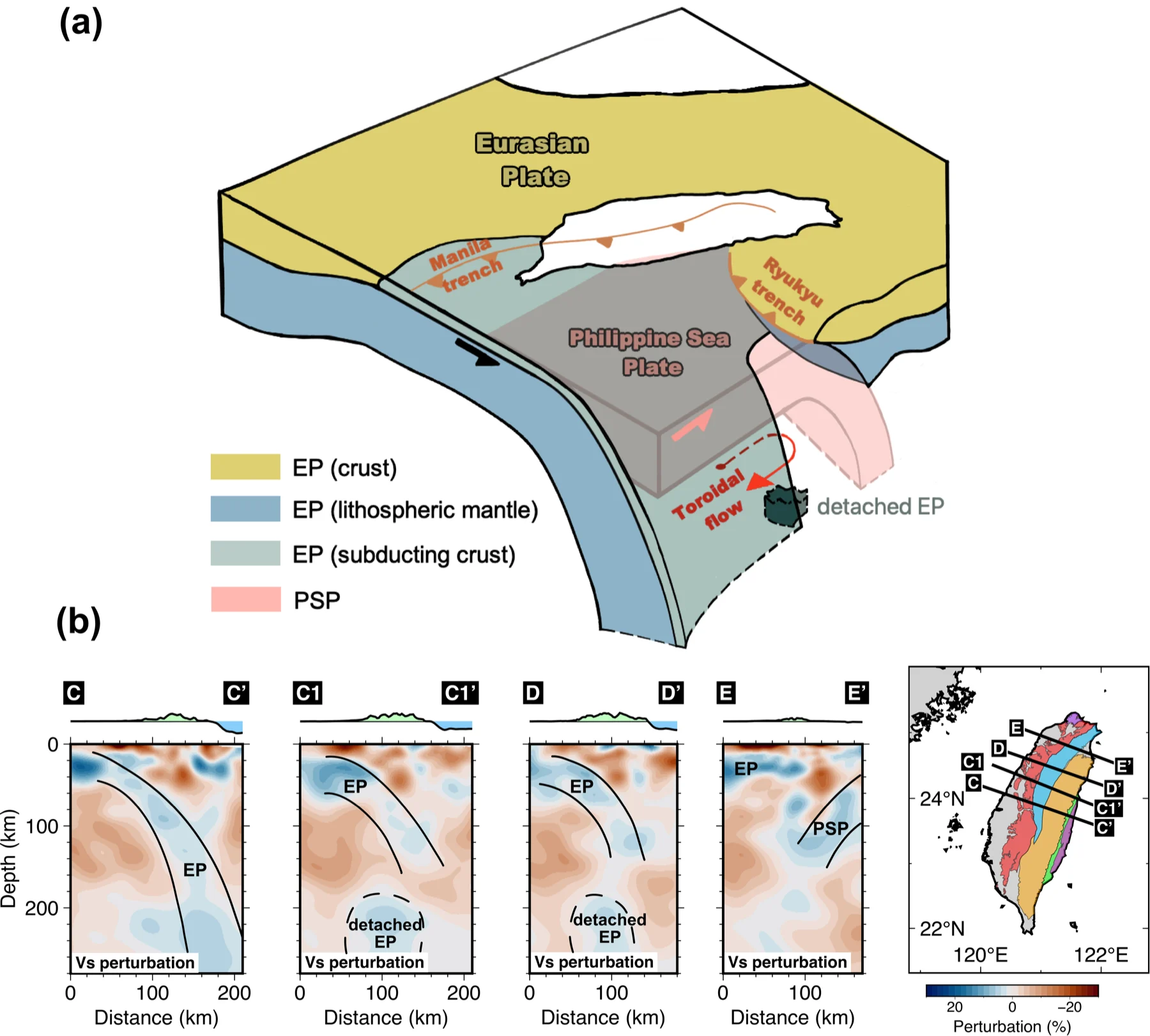
The most recent work applied the same methodology to Taiwan, a region shaped by arc–continent collision and subduction polarity reversal. By inverting complete P and SH teleseismic waveforms recorded across the island, the study produced high-resolution 3-D models of density, VP, VS, and VP/VS. Key findings include:
Imaging of the aseismic and detached segment of the Eurasian slab beneath central Taiwan, with a slab gap forming at 130–200 km depth north of 23.5°N, consistent with slab breakoff or tearing.
A thickened crustal root (>50 km) beneath the Central Range, with elevated VP/VS values in the lower crust, possibly reflecting fluid infiltration from slab dehydration.
Detailed velocity anomalies beneath the Tatun Volcano Group and Turtle Island, corresponding to shallow magma reservoirs.
Resolution tests (checkerboard models) confirmed that the method can reliably resolve structures at 20–60 km scale throughout the lithosphere, providing sharper images than conventional traveltime tomography.
Figure 12. Schematic interpretation and tomographic evidence of the Eurasian slab (EP) gap and detachment beneath Taiwan. (a) Schematic illustration of the subducting Eurasian Plate morphology; red arrows indicate toroidal mantle flow around the slab edge. (b) Vertical cross-sections of S-wave velocity perturbations; profiles C1–C1′ and D–D′ reveal a discontinuity in the subducting slab below ~130 km depth (slab gap), with the high-velocity anomaly to the west (dashed) interpreted as the detached EP segment.
Summary and Outlook
This series of studies demonstrates a complete research arc—from theoretical development, through field validation, to practical application in tectonically complex regions.
The results highlight the potential of multiparameter FWI to recover key geophysical properties and illuminate deep Earth processes such as fluid release, metamorphism, and crustal thickening.
Future applications may extend to other subduction zones, orogenic belts, and volcanic regions, contributing to a more accurate understanding of lithospheric dynamics.
Finite fault inversion is a powerful method for characterizing the spatiotemporal rupture processes of moderate-to-large earthquakes. It plays a critical role in advancing the understanding of earthquake source physics and improving ground motion predictions.
This research theme focused on two case studies: the 2016 Mw 7.0 Kumamoto earthquake in Japan and the 2014 Mw 6.1 Ludian earthquake in China, with key results summarized below:
For the Kumamoto earthquake, waveform inversion using strong-motion (K-NET and KiK-NET) and teleseismic (IRIS) data revealed that the main rupture propagated northeastward at shallow depths starting ~4 seconds after origin time and continued until ~14 seconds. The largest slip (~2.5 meters) occurred ~17 km northeast of the hypocenter. A simulated annealing algorithm was used to explore fault parameters on a 2.5×2.5 km subfault grid with a 1D velocity model.
For the Ludian earthquake, comparisons were made between inversions using 1D and 3D velocity models. The results showed that 3D structure significantly affects the accuracy of waveform fits and rupture models. The inverted slip distribution was further used in ground motion simulations via a finite-difference method, successfully reproducing the peak ground velocity (PGV) pattern, including areas of concentrated shaking.
This line of research integrates source inversion theory, waveform processing, structural modeling, and ground-motion simulation, demonstrating the utility of finite fault models for both seismic hazard assessment and fundamental earthquake science.
Finite-Frequency Body Wave Sensitivity Kernels for Inner Core PKP Phases
My master's research focused on the finite-frequency effects of body waves used to probe the Earth's inner core structure, particularly the sensitivity of PKP phases to velocity anomalies. Traditional studies often rely on differential traveltime measurements between PKP branches (e.g., PKPab, PKPbc, PKIKP), modeled using ray theory. However, ray theory assumes infinitely high-frequency waves and restricts sensitivity to the geometric ray path, failing to capture the volumetric nature of real seismic wave propagation.
To overcome this limitation, I adopted the axisymmetric spectral-element method (AxiSEM) to simulate wave propagation in a spherically symmetric Earth model. This approach reduces the 3-D spherical problem to a 2-D semi-disk domain under axisymmetric conditions, significantly reducing computational cost and allowing high-frequency simulations (up to 1 Hz) at global scale. By computing both forward and adjoint wavefields and performing their convolution using the Monte Carlo Kernel method, I obtained finite-frequency delay-time sensitivity kernels for various PKP phases.
The study analyzed the sensitivity patterns of key inner-core phases including PKPab, PKPbc, PKIKP, and PKiKP, and examined their differential traveltime kernels (e.g., PKPbc–PKIKP, PKPab–PKIKP, and PKiKP–PcP) to assess the influence of lower mantle heterogeneities on inner-core phase measurements. The results highlight the significance of the banana-doughnut–shaped sensitivity kernels, showing that observed traveltime anomalies do not solely arise from anomalies along the ray path but from broader volumes defined by the first Fresnel zone. This challenges the conventional interpretation of differential times as being sensitive only to turning depths or path intersections.
This work improves our understanding of how seismic waves sample deep Earth structures and demonstrates the feasibility of incorporating high-frequency finite-frequency kernels into global-scale inverse problems. It provides a computationally efficient framework for future studies aiming to resolve deep Earth heterogeneity with greater accuracy and realism, particularly in applications such as full-waveform tomography or high-resolution mantle and core imaging.
在模擬方法上,我們採用譜元素法(Spectral Element Method, SEM),搭配三維速度模型(Kuo-Chen et al., 2012)、ETOPO1 地形資料與一維衰減模型(Wang et al., 2010),建立細緻且具物理真實性的波傳場。各斷層最大潛勢震度以其幾何面積結合經驗公式估算地震規模,進行最大地震下三種不同震央位置的點源模擬。震源機制則依據現有斷層幾何與類型設置,三義斷層進一步區分為東西走向與南北走向兩段。
This study evaluates the seismic hazard and stress perturbation at the Tieh-Chen-Shan site, a potential location for geological carbon storage in western Taiwan. We conducted scenario-based numerical simulations of ground motion and static stress/strain changes associated with four active faults near the site (Tunzihjiao, Sanyi, Dajia, and Tieh-Chen-Shan faults), as well as the 1999 Chi-Chi earthquake (Mw 7.6), to assess the impact of strong earthquakes on site stability and storage integrity.
We employed the Spectral Element Method (SEM) to model seismic wave propagation, incorporating a 3D velocity model (Kuo-Chen et al., 2012), surface topography (ETOPO1), and a 1D attenuation model (Wang et al., 2010). Fault geometries and source mechanisms were defined based on published fault catalogs and empirical scaling relationships. The Sanyi Fault was further subdivided into EW- and NS-trending segments to capture the observed strike change. For each fault, three rupture scenarios with varying hypocenter locations were simulated using point-source approximations.
For each scenario, we calculated the Peak Ground Velocity (PGV) and mapped the corresponding intensity at the injection site. Static stress and strain changes were computed using the Okada (1992) elastic dislocation model via the Coulomb 3.3 code, assuming a dipping reservoir layer at ~1.4 km depth.
The simulations show that:
Most earthquake scenarios result in intensities no higher than Intensity 3 (Central Weather Bureau scale) at the site.
In a few scenarios (e.g., Sanyi NS rupture), the PGV may reach ~25 cm/s, corresponding to Intensity 5−, but the resulting co-seismic normal stress changes remain small, with a maximum increase of only +0.168 bar.
Even under the Chi-Chi earthquake scenario (which generated Intensity 5 at the site), the modeled stress increase is only +0.28 bar, far below the reservoir's estimated in-situ stress (~30 MPa).
These results demonstrate that, even under worst-case local and regional seismic conditions, the Tieh-Chen-Shan site exhibits high resilience against dynamic and static stress perturbations. The estimated stress variations are several orders of magnitude lower than the background pore pressure, implying negligible risk of structural compromise or induced leakage from CO₂ injection.
著作列表
Publications
Kan, L.-Y., Kuo-Chen, H., Chevrot, S., & Monteiller, V. (2026). Seismic imaging of the crust and upper mantle beneath Taiwan using full-waveform inversion of teleseismic body waves. Tectonophysics, 231301. https://doi.org/10.1016/j.tecto.2026.231301
Kuo-Chen, H., Sun, W.-F., Kan, L.-Y., Pan, S.-Y., Yen, I.-C., Liang, S.-H., Guan, Z.-K., Liu, Y.-H., Chen, W.-S., & Brown, D. (2025). Real-time earthquake monitoring with deep learning: A case study of the 2025 ML 6.4 Dapu earthquake and its fault system in southwestern Taiwan. The Seismic Record, 5(3), 320–329. https://doi.org/10.1785/0320250023
Kan, L.-Y., Monteiller, V., Socquet, A., Tavera, H., & Chevrot, S. (2025). Seismic imaging of the transition from normal to flat subduction in southern Peru by full waveform inversion of teleseismic waves. Journal of Geophysical Research: Solid Earth, 130(10). https://doi.org/10.1029/2025jb031254
Kan, L.-Y., Chevrot, S., & Monteiller, V. (2023). Dehydration of the subducting Juan de Fuca plate and fluid pathways revealed by full waveform inversion of teleseismic P and SH waves in central Oregon. Journal of Geophysical Research: Solid Earth, 128(4). https://doi.org/10.1029/2022jb025506
Kan, L.-Y., Chevrot, S., & Monteiller, V. (2022). A consistent multiparameter Bayesian full waveform inversion scheme for imaging heterogeneous isotropic elastic media. Geophysical Journal International, 232(2), 864–883. https://doi.org/10.1093/gji/ggac363